Sports & Entertainment

Contractual Stability, Inducement of Breach of Contract and Sporting Sanctions in Football Contracts — the Curious Case of Enyimba Football Club and Chibuike Nwaiwu

An examination of the FIFA RSTP framework on contractual stability, compensation clauses and inducement of breach, prompted by a Nigerian club’s very public struggle to keep hold of its playing staff.

Steve Austin NwabuezePartner & Head, Sports & Entertainment10 June 2025 8 min read

Last reviewed 10 June 2025

01 / 06

The Enyimba incident

Nigerian champions Enyimba Football Club recently went on social media to declare that one of their players had gone AWOL (away without leave). In a sudden twist, the missing Enyimba star, whose disappearance had baffled the club and its fans, was found in war-ravaged Israel. The discovery triggered a wave of reactions across the football community and highlights the challenges Nigerian club sides face in keeping playing staff, most of whom are obsessed with looking for greener pastures abroad. It was, therefore, no surprise the player was spotted in Israel, ostensibly on the invitation of another club.

This case represents the latest in a series of incidents involving NPFL clubs whose players abscond from team camps and unilaterally terminate their employment contracts in search of better opportunities abroad. In 2014, a number of Enyimba players failed to report to pre-season camp in Otta, Ogun State, prompting then Head Coach Zachary Baraje to issue an ultimatum. In 2019, both Kaduna City FC and Katsina United FC, in separate but related incidents, announced that a player in their employ had absconded without permission to attend trials abroad. We examine the regulatory and legal ramifications of this development in light of prevailing FIFA jurisprudence, and the legal permutations and options available to both parties.
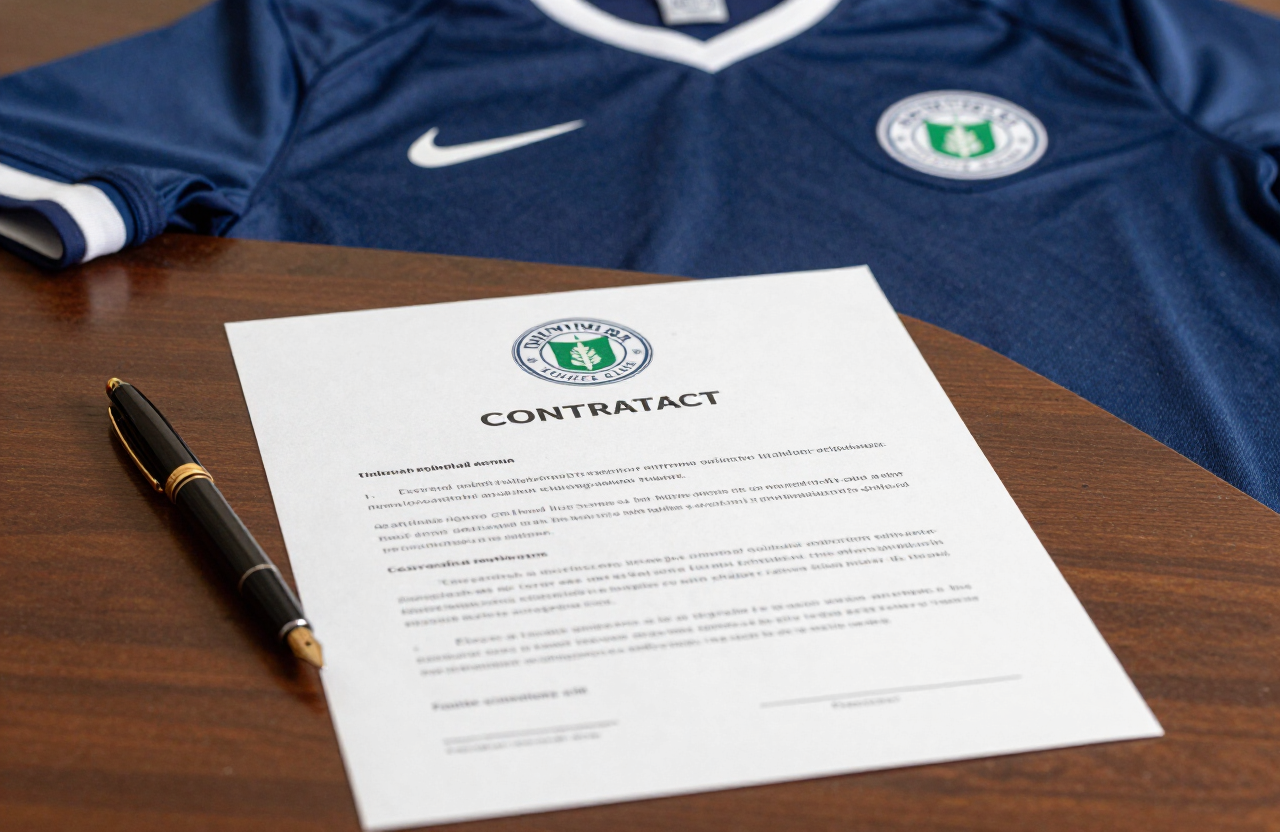
A club contract and pen — inducement of breach carries sporting sanctions as well as civil liability.
Fig.A club contract and pen — inducement of breach carries sporting sanctions as well as civil liability.
02 / 06

The aim of contractual stability

One of the main aims of the provisions on the maintenance of contractual stability is to create a level of sporting and contractual certainty for both players and clubs. On the one hand, clubs should be able to rely on the fact that, unless a premature termination of the contract is mutually agreed with the player, they will be able to count on the player’s services for a certain period, and at least until the end of the season. This is reflected in Article 18 paragraph 2 of the Regulations on the Status and Transfer of Players (RSTP), which states that the minimum length of a contract between a professional player and a club shall be from its effective date until the end of the season. This stability is key to allowing clubs to make sport-related plans; if there is a high risk the composition of a squad will vary significantly during a season, it becomes impossible for a coach to develop specific technical, strategic and tactical programmes. The obvious exception is the mid-season transfer window, where clubs can reshuffle playing staff.

On the other hand, the sporting and contractual certainty this provision creates is equally beneficial to individual players and their careers — unless a premature termination is mutually agreed with the club, the player has secure employment for a certain period, meaning both sporting and financial security. The downside is that it may be difficult for a player to find a new club during the season, particularly if he is not considered a world-class talent, since clubs are often reluctant to sign a new player unless sure how to integrate him into the existing squad.

03 / 06

Consequences of terminating a contract under the FIFA RSTP

The consequences of terminating a contract under the FIFA RSTP can be generally summarised as follows. If a player terminates a contract with just cause (Article 14 and/or 14bis, in conjunction with Article 17): no sporting sanctions apply to the player; sporting sanctions may apply to the club if the breach occurred during the protected period; compensation is payable to the player. If a player terminates without just cause during the protected period (Article 17): sporting sanctions may apply to the player; compensation is payable to the club. If a player terminates without just cause after the protected period (Article 17): no sporting sanctions apply to the player; compensation is payable to the club.

If a club terminates with just cause (Article 14 and/or 14bis in conjunction with Article 17): no sporting sanctions apply to the club; sporting sanctions may apply to the player if the breach was during the protected period; compensation is payable to the club. If a club terminates without just cause during the protected period (Article 17): sporting sanctions may apply to the club; compensation is payable to the player. If a club terminates without just cause after the protected period (Article 17): no sporting sanctions apply to the club; compensation is payable to the player. If a player terminates with sporting just cause (Article 15): no sporting sanctions apply to either the player or the club, though compensation may be payable to the club.

04 / 06

Contractual compensation clauses

The first element considered by Article 17 paragraph 1 of the RSTP is whether any existing contractual clauses establish in advance an amount due from the party at fault in the event of a breach. Parties may include a compensation clause establishing in advance the amount payable by each party in case of breach — a legal requirement in some countries, such as Spain, for contracts between professional players and clubs; other countries, such as France, prohibit such clauses because they are incompatible with domestic statutory employment law. There is presently no such domestic regulatory framework in the NPFL, and the author is not privy to the terms of the employment contract between Enyimba and the player in question, nor to any compensation clause it may contain.

Contractual compensation clauses fall into two distinct categories. A “liquidated damages” clause requires the parties to assess and estimate in advance the damage that might be caused if the contract is terminated early due to a serious breach by one party — the parties establish, prior to signing, the amount that becomes due in compensation if such an event occurs. A “buy-out” clause is different: rather than setting a compensation amount payable by the party at fault, it confers a right on one party to terminate the contract unilaterally and prematurely in return for unconditional and complete payment of a predetermined sum.

Most Nigerian club sides do not include compensation clauses, especially given the prevailing practice of short-term contracts. Inserting a liquidated damages clause would save both club and player a great deal of trouble by putting any potential claim against the defaulting party on a strong footing — once the quantum of compensation is ascertained, any claim filed before the FIFA Football Tribunal can be expeditiously determined.

05 / 06

Joint and several liability and inducement

Another vital principle in deciding cases of this nature, particularly where a player has joined another club during the subsistence of his contract, is the joint and several liability of the player and his new club, founded on the principle of inducement of breach. The trite principle is that whenever a player must pay compensation to a club for breach of contract, the player’s new club will be jointly and severally liable to pay that compensation. Article 17 paragraph 2 is aimed at avoiding any debate or evidentiary difficulty regarding the new club’s potential involvement in the breach: it states the new club will be held liable, together with the player, regardless of whether the club induced the breach, and without regard to its good or bad faith. This gives the former club a stronger guarantee that compensation will in fact be paid, and has been interpreted in football jurisprudence as giving the new club standing to be sued — a presumption that the new club must be involved in any claim for compensation, such that the aggrieved club must join the new club to the dispute.

Article 17 paragraph 4 explicitly states that sporting sanctions should be imposed on any club found to have induced a breach of contract — conduct that is neither permitted nor acceptable under any circumstances. The premature termination of a contract without just cause undermines the principle of contractual stability, as does a club approaching a player and inducing them to breach an existing contract. Inducement is regarded as accessory to the actual breach, which leads to two conclusions: first, there can be no claim for inducement against a club without a corresponding claim for breach against the player; second, the relevant sporting sanction may only be imposed on the inducing club where the player terminates without just cause during the protected period. Inducing a player or club to breach an existing valid contract is against the very principle and spirit of contractual stability and cannot be tolerated. This principle applies not only to clubs but to any person subject to the FIFA Statutes and regulations, who will face sanction if they act in a manner designed to induce a breach of contract to facilitate a player’s transfer.

06 / 06

Applying this to Enyimba’s case

From the scenario above, it is clear the player in question, spotted with an Israeli club, is either already contracted to that club or has been induced to negotiate an employment contract with them. Enyimba can consider bringing a claim before the FIFA Football Tribunal against the player and his new club for termination of contract without just cause, if it reasonably believes there is no just cause for the termination. The author is unaware of any precedent involving a Nigerian club side in this regard, and this might well be a test case.

This article is provided for general information only and does not constitute legal advice. It is not a substitute for specific advice on any particular matter.Kempes & Kaplan LP accepts no responsibility for any loss arising from reliance on this material.

Engage counsel

Discuss how this applies to your matter.

Book a call with us